

The Last-Mile Crisis: How AI-Powered Delivery Management Cuts Costs by 30%
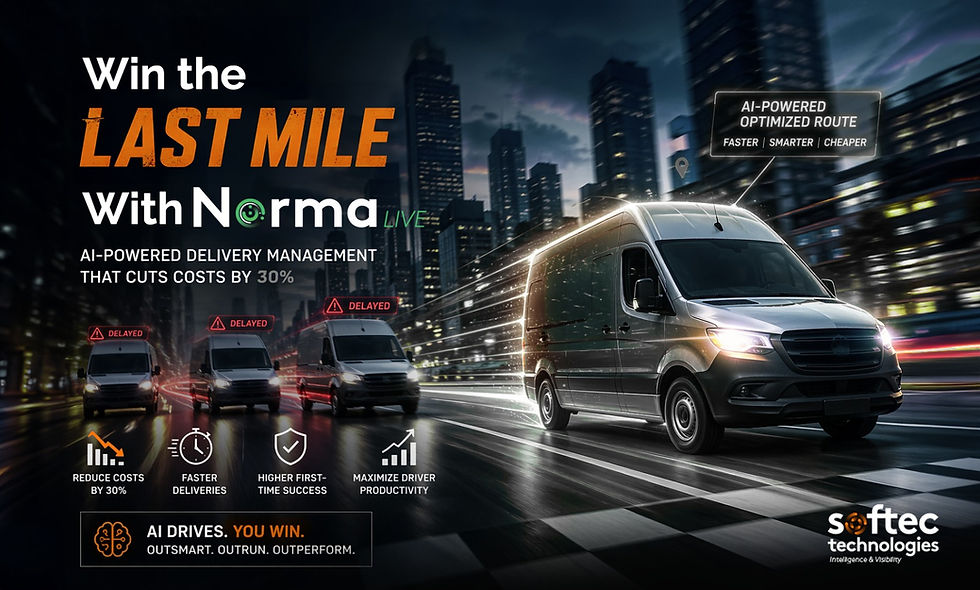
The last mile represents the final leg of a delivery journey—and it's the most expensive, most complex, and most visible part of any logistics operation. Across the MENA region, where rapid urban expansion, traffic congestion in major cities, and growing e-commerce demand are reshaping logistics, this stage has become even more critical.
In fact, last-mile delivery accounts for nearly 48% of total shipping costs, yet it's where most operational failures and customer dissatisfaction occur. From heavy traffic in cities like Riyadh and Cairo to customer availability challenges and address inconsistencies, logistics teams face a constant battle to deliver on time and at scale.
But what if your delivery operations could anticipate these problems before they happen? What if AI could automatically optimize every single route in real-time, eliminating inefficiencies while delivering faster and more reliably?
In this blog post, you'll discover how AI-powered delivery management systems are transforming last-mile logistics in the MENA region—and why companies that adopt these solutions today will lead tomorrow’s market.
The Economics of Last-Mile Failure
Traditional last-mile operations are built on reactive problem-solving. A driver gets stuck in traffic—the delivery is delayed. A customer isn’t available—resources are wasted. Demand spikes during peak seasons like Ramadan or major sales events—operations struggle to keep up.
Each of these scenarios costs money, frustrates customers, and weakens competitive positioning.
Consider the numbers:
67% of customers will abandon a purchase if delivery timelines are unclear
Late deliveries cost 2.5x more in customer acquisition to recover lost trust
Manual routing decisions result in 20–30% inefficiency
Driver idle time during failed deliveries costs the global industry billions annually
The challenge isn’t effort—it’s complexity. In MENA markets, planners must deal with traffic variability, delivery density differences between urban and suburban areas, and rapidly changing order volumes. No human planner can process all these variables in real-time. This is where AI becomes essential.
What is AI-Powered Delivery Management?
AI-powered delivery management systems use machine learning, real-time data, and predictive analytics to shift operations from reactive to proactive.
These systems continuously analyze:
Traffic conditions in real-time
Customer delivery patterns and availability
Driver locations and capacity
Weather and external disruptions
Order volumes and demand fluctuations
Unlike traditional tools that plan routes once per day, AI systems dynamically adjust routes throughout the day—ensuring optimal performance even as conditions change.
Key capabilities include:
Real-Time Route Optimization AI recalculates routes minute-by-minute based on live traffic and delivery conditions, especially valuable in high-density cities across the region.
Predictive Failure Detection AI identifies at-risk deliveries before they fail—whether due to customer availability patterns or route delays—and enables proactive action.
Dynamic Task Allocation Deliveries are automatically reassigned to the nearest available driver, improving efficiency and reducing delays.
Demand forecasting AI anticipates spikes during peak seasons like Ramadan, Eid, or major retail campaigns, helping allocate resources in advance.
Customer Availability Intelligence AI predicts when customers are most likely to be available, improving first-attempt delivery success rates.
How AI Cuts Last-Mile Costs by 30%
The impact of AI-powered delivery management is measurable and immediate. Logistics companies across emerging and high-growth markets report strong improvements:
1. Reduced Delivery Failures
First-attempt delivery failure rates drop from 15–20% to as low as 3–5%, reducing costly re-delivery operations.
2. Route Efficiency Gains
AI reduces total distance traveled by 15–25%, helping companies cut fuel costs and delivery time—critical in large urban areas.
3. Driver Productivity Surge
Drivers complete 20–30% more deliveries per shift, enabling companies to scale operations without increasing fleet size.
4. Inventory Optimization
AI forecasting reduces both stock shortages and excess inventory, improving capital efficiency and service levels.
5. Reduced Manual Operations
Automation replaces 70–80% of manual planning decisions, freeing up teams to focus on strategic tasks instead of daily firefighting.
Combined, these improvements lead to 25–35% total cost reduction—with even higher savings for companies operating at scale.
The Competitive Advantage: Speed and Customer Experience
In the MENA region, where customer expectations are rapidly evolving, delivery experience is becoming a key differentiator.
AI-powered delivery management enables the following:
Faster Deliveries — enabling next-day or even same-day delivery at optimized cost
Accurate Delivery Windows — replacing vague timeframes with precise ETAs
Higher Reliability — achieving 97%+ first-attempt success rates
Proactive Communication — informing customers of delays or changes before issues arise
Companies that excel in last-mile delivery don’t just reduce costs—they build stronger customer trust and long-term loyalty.
Future-Proofing Your Logistics in MENA
As e-commerce continues to grow across the Middle East and North Africa, logistics complexity will only increase. Companies relying on manual processes will struggle to keep up with demand and expectations.
Those adopting AI-powered delivery management will operate with:
Greater efficiency
Real-time visibility
Scalable operations
Higher profitability
The transformation is already happening across the region. The question is: will your company lead it—or struggle to catch up?
Ready to Optimize Your Last-Mile Operations?
The future of logistics in MENA is intelligent, adaptive, and data-driven.
See how AI-powered delivery management can help you:
Cut last-mile costs by up to 30%
Improve delivery performance
Deliver the experience your customers expect
Book a demo today and discover how AI can transform your delivery operations into a competitive advantage.


Comments